An Evening Under the Northern Lights
The best part of an aurora night may be the waiting: dark hills, cold air and the gradual realization that the sky has started to move.
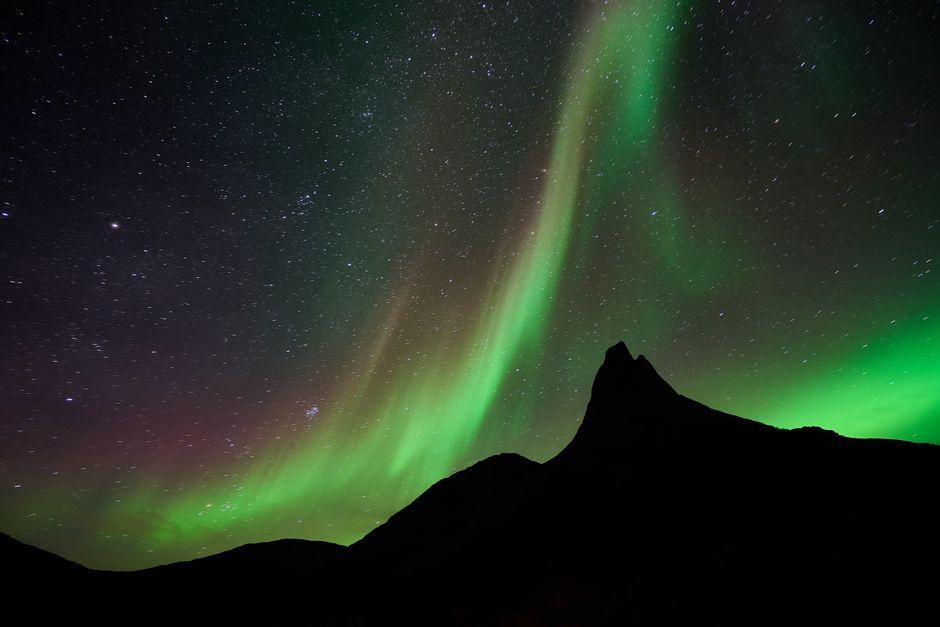
The first surprise about watching the northern lights is how much of the evening can look completely ordinary. There is a dark road, a darker hill, the sound of wind against a coat, and a sky that seems no different from any other clear night.
Then a pale band appears where you are not sure you saw one before. It is easy to mistake for cloud. A few minutes later the band has shifted, brightened and divided into shapes that do not behave like weather. The waiting suddenly makes sense.
Photographs have trained many of us to expect instant curtains of electric green. Cameras can gather light differently from our eyes, so the first visible aurora may be subtler than the familiar images suggest. That does not make the experience smaller. In person, movement is the important part: the slow folding, the faint pulse, the sense that a huge section of sky has become active.
Give the darkness some time
It helps to arrive before anything happens. Let your eyes adjust. Learn the outline of the nearest ridge and the direction of the road back. Notice where distant town light sits on the horizon. Once the landscape becomes familiar, small changes overhead are easier to see.
Warm layers matter more than elaborate equipment. A thermos and gloves can contribute more to the evening than another lens. If you bring a camera, set it up and then step away from it for stretches of time. The urge to check every frame can make a rare sky feel strangely like a screen-based task.
There is also pleasure in not knowing exactly when the display will strengthen or fade. The night refuses to behave like an appointment. People talk more quietly. Cars arrive and leave. Someone points at a faint streak; someone else is convinced it is only cloud. Then the whole group becomes silent at once when the color intensifies.
Later, the strongest memory may not be the brightest moment. It might be the crunch of frost beside the road, the mountain turning into a black paper cutout, or the way the first green arc seemed to emerge from nothing.
That is the useful lesson of an aurora evening: anticipation is not merely the time before the event. Sometimes it is the event, giving the landscape enough room to become memorable before the sky does anything remarkable at all.